The Jordan Factor™ · Resource

The RADAR Self-Assessment

See where structure is quietly slipping before it becomes expensive.

Most growing businesses do not feel structure slipping at first.

They feel it in slower decisions.

They feel it in fuzzy ownership.

They feel it in reports that take too long to trust.

They feel it when risk shows up after the cost has already arrived.

The RADAR Self-Assessment is a practical worksheet for leadership teams that want to see where growth may be outpacing the operating model, across Reporting, Accountability, Decision Rights, Alignment, and Risk.

This is not a test you pass or fail. It is a pattern read.

By submitting this form, you agree to receive the RADAR Self-Assessment Worksheet and related follow-up from The Jordan Factor.

See what the assessment reveals
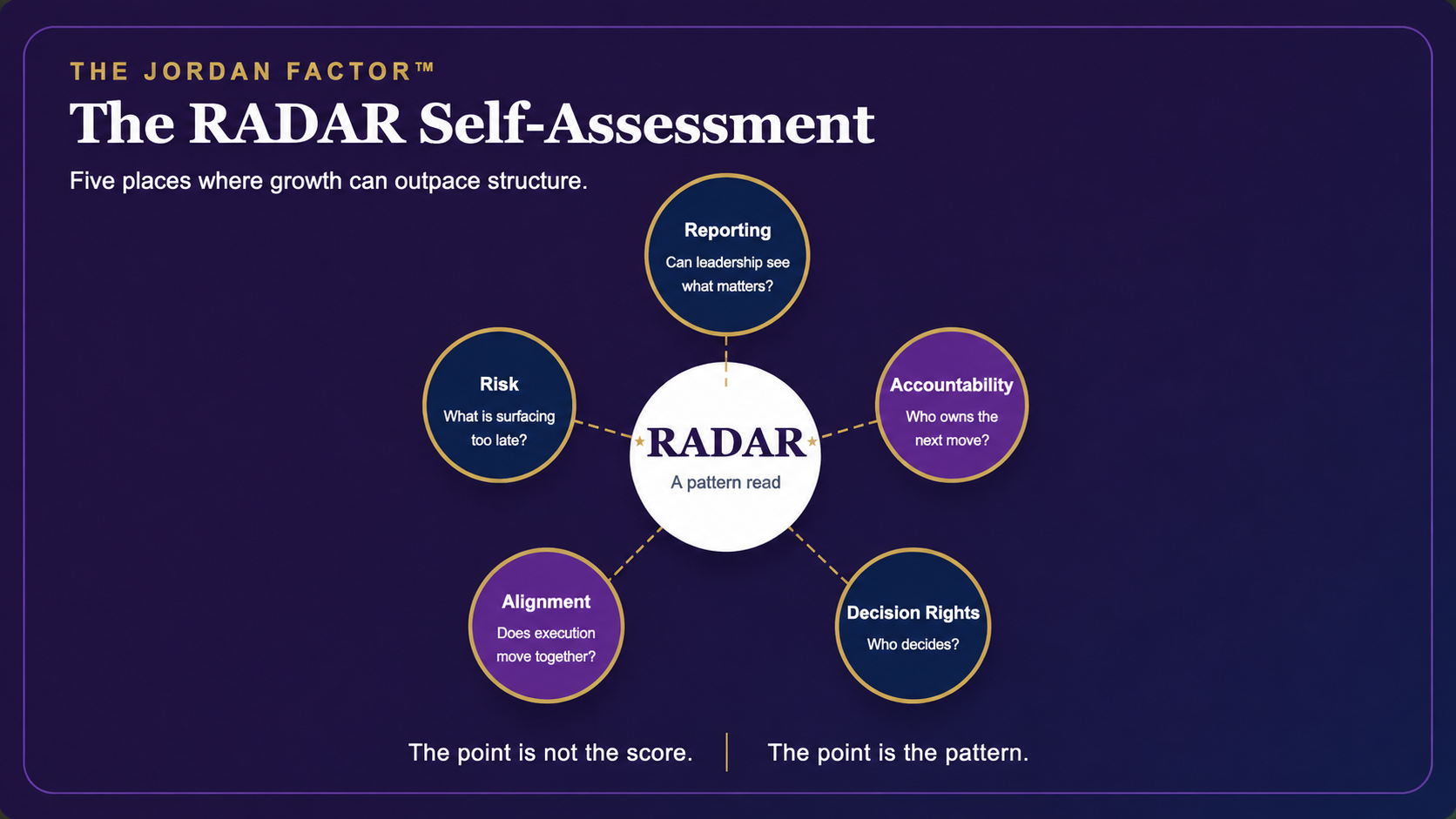
The five RADAR dimensions: Reporting, Accountability, Decision Rights, Alignment, and Risk.

What the assessment reveals

Where pressure is showing up, and what it is asking for.

Growth creates pressure.

Sometimes that pressure shows up in the numbers. Sometimes in meetings. Sometimes in the quiet gap between what leadership believes is happening and what the business can actually show.

The RADAR Self-Assessment helps surface where that pressure may be coming from. It gives leadership a structured way to ask:

  • Can leadership see what matters?
  • Does everyone know who owns the next move?
  • Is it clear who decides?
  • Does execution move in the same direction after decisions are made?
  • Can the business see risk before it becomes expensive?

The value is not in a perfect score. It is in seeing the pattern clearly enough to decide what needs attention first.

Who this is for

Leadership teams in businesses that are growing, changing, or harder to see and manage.

It is especially useful when:

  • Leadership meetings keep circling the same issues
  • Reports exist, but they do not create clear decisions
  • Work crosses functions and ownership gets blurry
  • Teams are moving, but not always in the same direction
  • Risk is visible only after something has gone sideways
  • AI tools are being discussed before the underlying workflow is clear

If the business feels more complicated than it used to, that does not always mean something is broken. It may mean the structure that carried the business to this point needs to be made more visible, explicit, and usable.

The five dimensions

Five places where growth can quietly outpace structure.

Dimension 01

Reporting

Can leadership see the state of the business clearly enough to act?

This covers the numbers, operating metrics, cash position, pipeline, risks, and signals leadership relies on to make decisions. When reporting is weak, decisions slow down because people are waiting for information, questioning definitions, or working from different versions of the truth.
Dimension 02

Accountability

When something slips, does everyone know who owns the next move?

Accountability is not just about responsibility after something goes wrong. It is about knowing who owns the work before pressure hits. When accountability is unclear, issues get absorbed, explained away, or passed between functions until the business pays for the delay.

Dimension 03

Decision Rights

When a decision needs to be made, does everyone know who decides, who advises, and who is informed?

An org chart shows reporting lines. Decision rights show where work moves. When decision rights are fuzzy, meetings loop. People wait. The loudest or most available person may move the work forward, but not always with clear authority.

Dimension 04

Alignment

Once a decision is made, does execution move in the same direction?

Alignment is where strategy becomes coordinated action. When alignment is weak, people may hear the same decision and walk away with different assumptions, priorities, timelines, or definitions of success.

Dimension 05

Risk

Can leadership see the risks that matter before they become expensive?

Risk is operational, financial, strategic, and human, not only compliance. When risk visibility is weak, the business finds out too late: after the client issue escalates, cash tightens, the key person leaves, or the workflow breaks under volume.

What is inside the worksheet

A working document for leadership, not a quiz.

Use it on your own first, or ask each member of your leadership team to complete it separately before discussing the answers together. The gaps between responses often reveal as much as the scores themselves.

  • 12 practical questions across the five RADAR dimensions
  • A 1 to 5 rating scale
  • Space to capture notes and evidence
  • A snapshot scorecard
  • Prompts for comparing leadership responses
  • A pattern read section
  • A next-step action map
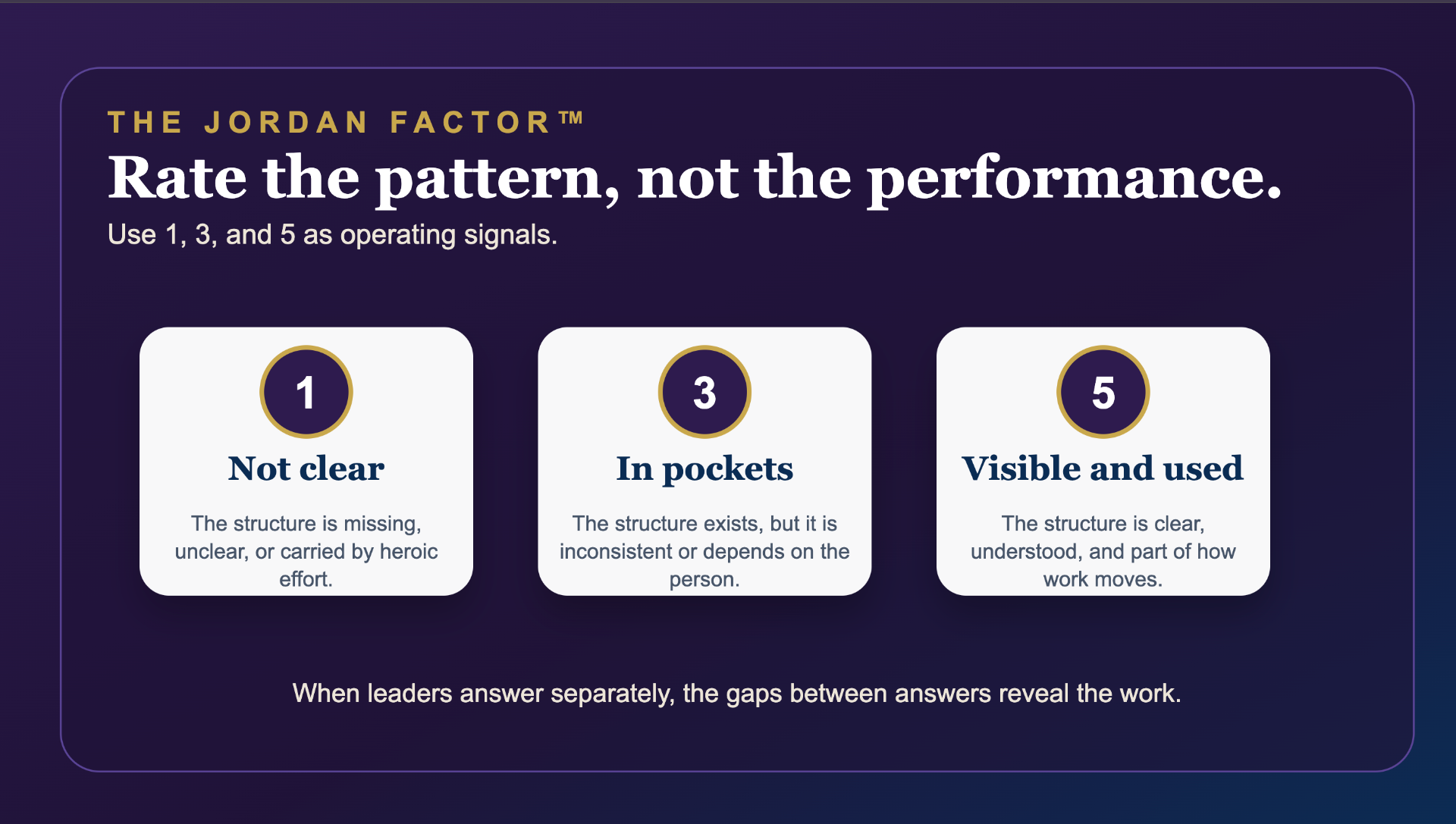
A 1, 3, 5 scale explaining structure that is not clear, structure that exists in pockets, and structure that is visible and used.

A preview

A few of the questions the worksheet will help you answer.

The full worksheet walks through 12 questions. Here is a preview of the kind of patterns it is designed to surface.

Reporting

How long does it take to get an answer leadership trusts?

Accountability

When something slips, does everyone know who owns the next move?

Decision Rights

When a decision needs to be made, does everyone know who decides?

Alignment

When execution is not working, does leadership know early enough to act?

Risk

Can the business see risk before it becomes expensive?

These questions are simple on purpose. If the answers are hard to give, that is the signal.

How to use the worksheet

Fifteen to twenty minutes. Rate the pattern, not the performance.

1

Not clear

The structure is not clear or not installed.

3

In pockets

The structure exists in pockets, but it is inconsistent.

5

Visible and used

The structure is clear, visible, and used.

Look for three things.

The lowest dimension

Where friction is most visible.

The widest leadership gap

Where people may be experiencing the same business differently.

The area closest to growth

Where small structure gaps can become expensive quickly.

Do not use the assessment to assign blame. Use it to name what the business is asking for next.

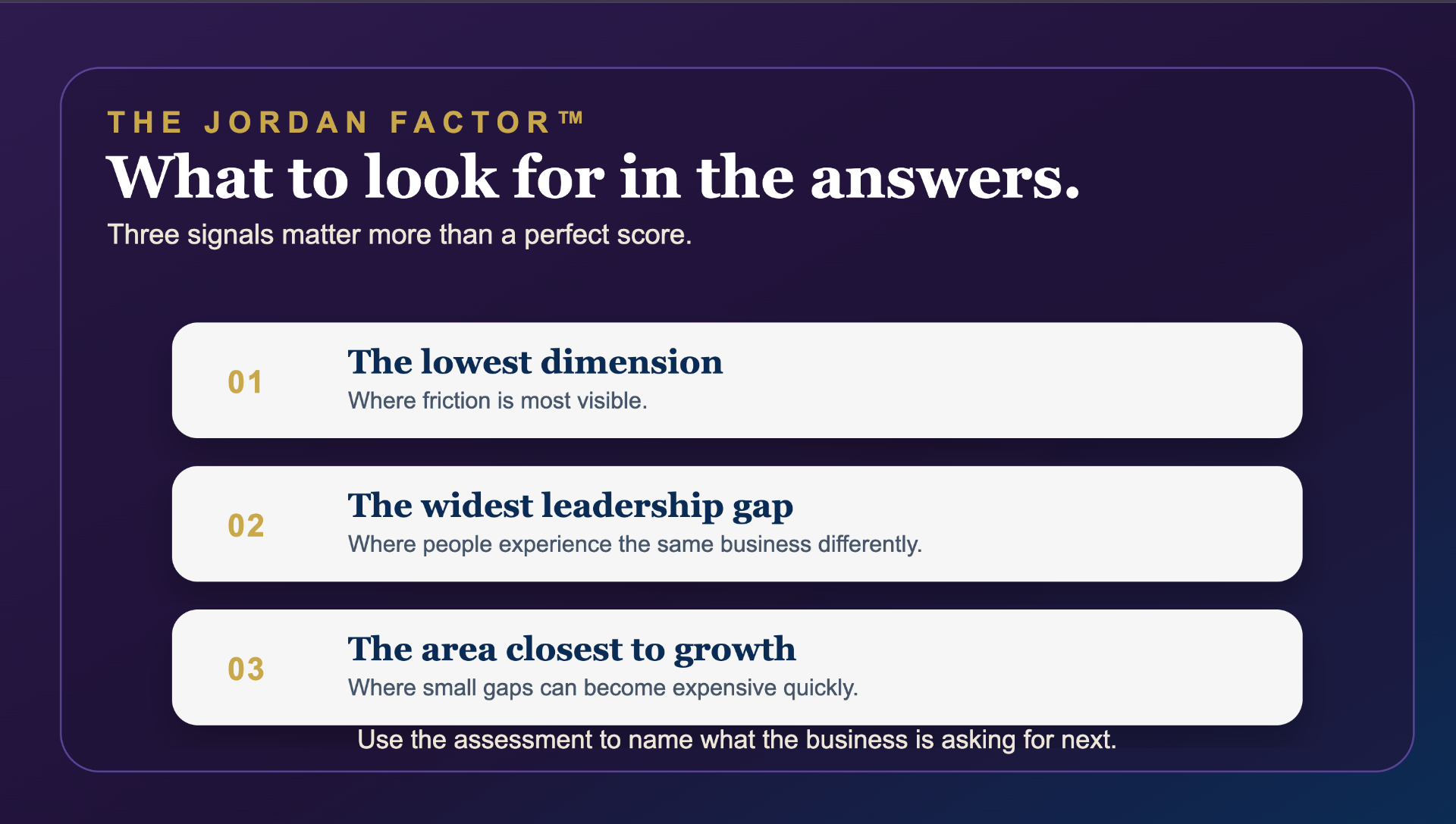
Three signals to look for in the RADAR answers: the lowest dimension, the widest leadership gap, and the area closest to growth.

Download the RADAR Self-Assessment Worksheet.

Get the full 12-question worksheet to rate your business across reporting, accountability, decision rights, alignment, and risk. Use it before your next leadership meeting, planning conversation, or operating review.

By submitting this form, you agree to receive the RADAR Self-Assessment Worksheet and related follow-up from The Jordan Factor.

The strategic next step

Ready to read the pattern with a strategic partner?

The business that built you is not always the business that will carry you forward. But the structure that carries you forward is often closer than you think.

The Structure Read turns patterns like these into a practical operating map: what leadership needs to see, who owns what, where decisions are stalling, and where risk is surfacing too late.

If your worksheet shows friction across multiple dimensions, The Structure Read is the next step.

What may come after The Structure Read

Depending on what the assessment reveals, the next step may be one of these.

Strategic Advisory

Strategic Advisory may fit when leadership needs ongoing structure, governance, and decision support.

Embedded Execution

Embedded Execution may fit when the business needs someone inside the operating rhythm to build and install the structure.

The Practical AI Bridge™

The Practical AI Bridge™ may fit when the workflow is clear enough to identify practical AI opportunities with governance, controls, and operational value built in.

Use the assessment to see the pattern. Use The Structure Read to decide what to build next.