TJF Insight · Structure Intelligence
The Friction Tax.
The Hidden Cost of Growth Without Structure
The CFO pulls the deck the night before the board meeting. The numbers tie out. The story does not.
Revenue is up. Margin is holding. But inside the operating model, everything is taking more effort than it should. Decisions are slower. Reports need cleanup before anyone trusts them. The founder is still answering questions the business should be able to handle without escalation.
That is the friction tax. And if you are feeling it, the issue may not be lack of effort. It may be the structure underneath the work.
Defining the Pattern
What the friction tax is.
Friction tax is the hidden cost of operating with more complexity than the business is structurally prepared to manage.
It does not show up as one dramatic failure. It shows up as drag: the meeting before the meeting, the report that needs three explanations before anyone trusts it, the decision that keeps circling back, the handoff where context disappears.
By the time leaders feel it, they are usually calling it something else: communication issues, capacity constraints, execution gaps, team burnout, AI adoption challenges.
Those may all be true. Underneath them, there is often a shared pattern.
The business has grown beyond the model that used to work.
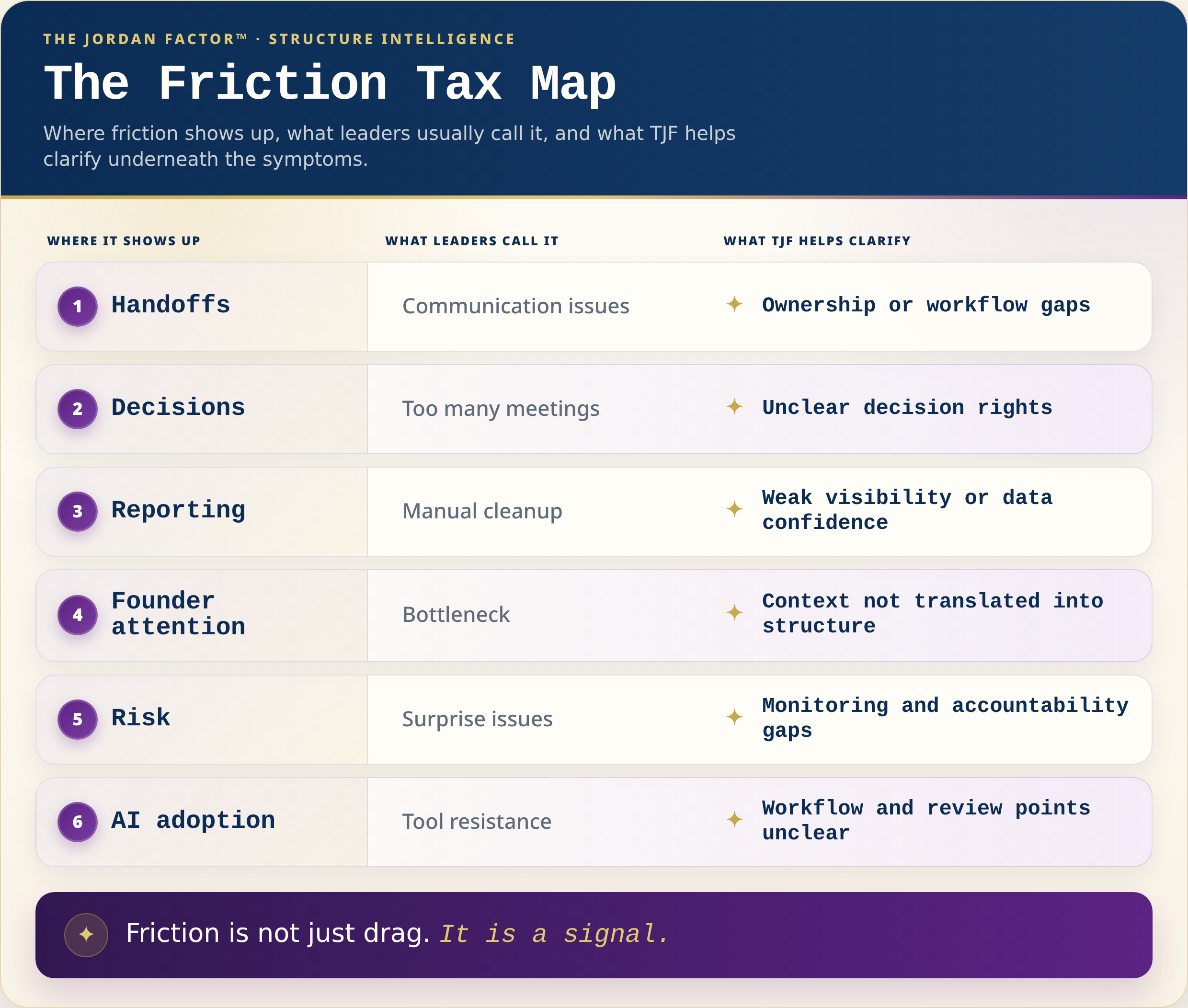
Reading the Signal
What the map is telling you.
Friction concentrates in predictable places. And when it does, it is not just slowing the business down. It is showing you where structure has not kept pace with complexity.
The decision that keeps circling is not just a people problem. It is a decision rights problem. The report that needs manual cleanup is not just a systems problem. It is a visibility and accountability problem. The founder still in every conversation is not just a capacity problem. It is a structure problem.
Friction is not the root cause. It is the signal.
And the longer it goes unnamed, the more the business builds around it. Teams create workarounds. Leaders absorb the gap. The friction becomes the operating model. That is when it compounds.
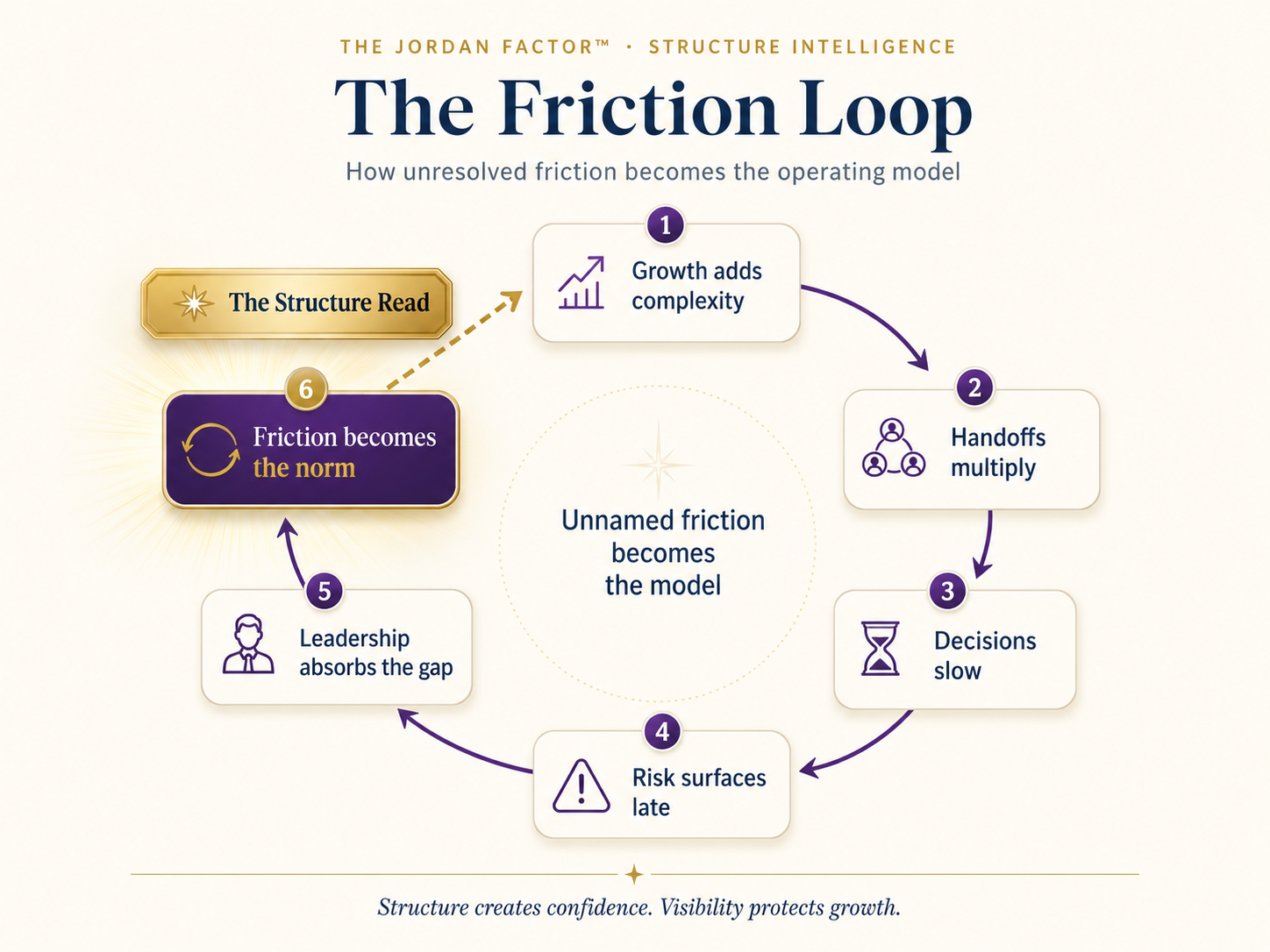
The Work Underneath
Where TJF comes in.
TJF does not start by adding more tools, dashboards, or process overlay. It starts by identifying what is creating the drag underneath the symptoms.
Through The Structure Read, TJF looks across your operating model: reporting, accountability, decision rights, workflows, risk, and AI readiness. It surfaces where growth has created pressure and what needs to change so the business can move with more clarity.
The goal is not to eliminate all friction. Some friction is useful: review, challenge, risk discussion. The problem is unmanaged friction, the kind that slows the business without improving the outcome.
The Structure Read separates symptoms from causes, clarifies what is structural and what is not, and identifies the specific changes that would make the biggest difference. In two weeks, you have a clearer picture of what is getting stuck and why.
START WHERE THE FRICTION IS SHOWING UP.
You do not have to know the root cause before you begin. Start with the signal you can see most clearly.
Not sure where friction is hiding?
RADAR Self-Assessment
Reporting, Accountability, Decision Rights, Alignment, Risk.
Start hereDecision-making is where it keeps getting stuck?
Decision Rights Mapping Template
Clarify who decides, who advises, and who needs to know.
Use the templateFeeling the drag across reporting, decisions, and AI readiness?
The Structure Read
Surface where growth has created pressure and what needs to change next.
Start with The Structure ReadStop Paying the Friction Tax.
If your business is working hard but still feels harder to manage than it should, the issue may not be effort. It may be structure.
START WITH THE STRUCTURE READ